

Primrose
Primula vulgaris

Nothing tastier than Primrose Pottage for supper of an early spring evening. Or at least that’s what you might have thought if you were around in Tudor times when it was a highly popular dish. You’d make your pottage1 by boiling the pounded flowers for hours, together with honey, almond milk, saffron, rice (at that time quite a luxury) and ginger. If the idea of Primrose Potage appeals, now would be the time to make it with the pretty yellow flowers being in full bloom. (Just make sure you use Primula vulgaris as hybrid Primula flowers can be poisonous.)

The name ‘Primrose’ comes from the Latin, ‘Prima Rosa’, meaning the first rose or flower. And the same for the scientific name ‘Primula’.
When it came to Middle English, the ‘L’s and ’S’s seem to have become a little mixed up, as Richard Prior MD pointed out in 1878, referring to Chaucer’s use of ‘prymerole’ in his Canterbury Tales:
“She was a primerole, a piggesnye, For any lord to leggen* in his bedde.”
*2
In the Middle Ages, both ‘prymerole’ (primrose) and ‘piggesnye’ (pig’s eye) were terms of endearment for a girl or woman. Fair enough to be compared to a primrose, not so sure about a pig’s eye though (no offence to pigs).
Later, in the “The Grete Herball” of 1526, the Primrose was called Pryme Rolles:
“It is called Pryme Rolles of pryme tyme, because it beareth the first floure in pryme tyme*.”
*3
Say the Early Modern English word ‘prime rolles’ out loud, and we’re pretty much back to ‘Primrose’, the ‘L’s becoming almost silent. One other species was named as an early flowerer: in the German book of natural history, the ‘Ortus Sanitatus’ (1486), gave the honour of the name ‘Premula’ to the daisy.

Primroses don’t just brighten up our cold, grey late winter days. Their leaves also contain vitamin C and the plant was believed to have numerous healing powers, often similar to those of its cousin, the humble Cowslip. Pliny (23-79AD) was already using Primroses as a remedy for rheumatism, paralysis and gout; Culpeper (1616-1654) used it in wound-healing salves and as an anti-wrinkle cream; and Gerard (1545–1612) knew of Primrose’s mild sedative properties and its use as a cure for hysterics. He wrote that Primrose tea:
‘drunk in the month of May is famous for curing the phrensie.’
Like its cousin the Cowslip, Primroses were associated with fairies. In various places across the British Isles, house and stable doors were decorated with the yellow flowers at Beltane (1st of May) to ward of bad fairies, witches and bad fortune. It was also used to prevent cattle from falling ill and to stop fairies stealing their milk. In some areas this pagan custom was transferred to Christian traditions (as often happened in the early days of Christianity), for example the decorating of altars with their flowers on May Day for St Mary, and in other places for St John of Beverley (7th of May).

But don’t bring those buttery yellow flowers into the house: the practice was known to prevent duck and chicken eggs from hatching. For each flower you took inside, one less egg would hatch.
Similarly to Coltsfoot, early herbalists and pagan traditions of that time, place the flowering period of the Primrose much later (early May) than we experience today. At the time of writing it is the 1st of March and I’ve seen many Primroses in bloom for a week or two now. Again I wonder, climate change?
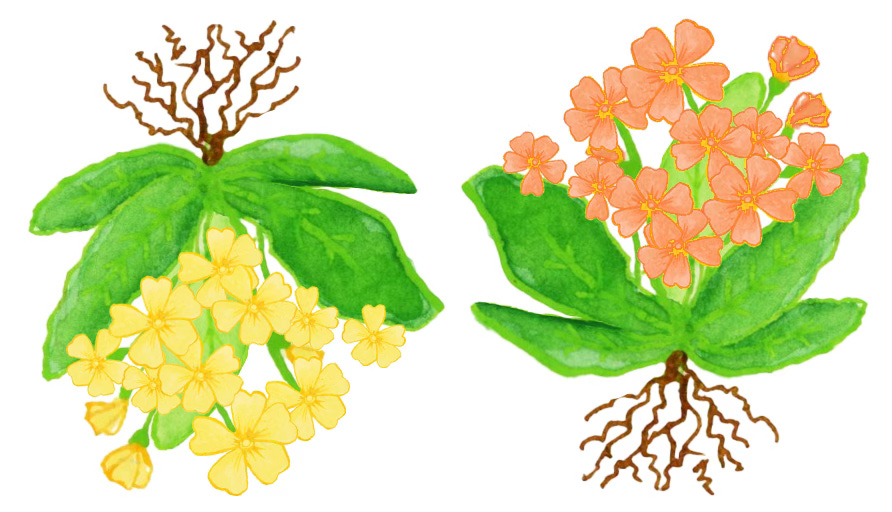
Last, but not least, according to an old countryside belief, if you plant your yellow primroses upside down, they will bloom pink or red the next year, especially if you add some bull’s blood. But if you happen to do this in Norfolk, your primrose will turn into a cowslip. And vice versa. You have been warned.
Other names mostly refer to its yellow blooms and its early flowering: Butter Rose, Jack in Box, Jack-in-the-Green, King-Charles-in-the-Oak, Lady’s Frills, Milk Maid, Primorole, St. Peter’s Wort, Summeren, Spink or May Spink (in Scotland), Buckie-Faalie, Darling-of-April, Early Rose, Easter Rose, First Rose, Golden Rose, Golden Stars, Lent Rose, May-Floor, Simmering (from Norwegian ‘kysymre’, cow anemone) and Summerlocks.

Flowerology is a reader supported publication. To support my work you might consider to subscribe for free,
buy me a tea to help keep me awake when researching ancient herbals and plant-lore books till deep in the night (Thank you!)
or simply click the heart shaped ‘like’ button on the top or bottom of this post (it supposedly helps the algorithms). Thank you so much!
If you are looking for the etymology of a specific wildflower, you can find all flowers covered so far in Flowerology in the alphabetical archive.
You can find a list of all the books used for researching Flowerology in the Reading List which is frequently updated with new etymology dictionaries, herbals and plant lore books.
This newsletter is NOT a field guide for flower identification. It’s often difficult to tell the difference between harmless plants and poisonous plants and some flowers are rare and protected by law, so, NEVER pick or use any plants or flowers if you’re not sure about them.
illustrations and text ©Chantal Bourgonje
Pottage: a dish slowly cooked, sometimes for days, in a pot or cauldron
Leggen: middle English for ‘lay’ (and modern Dutch for that matter, and ‘legen’ in German)
Pryme Tyme: Early Modern English for springtime
My daughter has a stick, that's about her height. It's decorated with flowers and ribbons and she calls it her "Elfenstab" (fairy stick). Today she put some primrose flowers on it and was very delighted, when I could tell her, that she has a real fairy flower on there now. 😄
I loved learning more about the pretty primrose! I too have seen them in flower for the past couple of weeks - it felt early to me.