

Chives
Allium schoenoprasum


Some sources tell us wild Chives are scarce, some that they’re common; some say they tend to occur in the south west and Wales, and others that you’ll find them up north as well; in terms of the type of soil they favour there are authorities who say it’s limestone and sparse ground while others claim they can thrive almost anywhere. So, when it comes to determining where you’re likely to find them, wild chives are a little difficult to pin down. Fortunately, when it comes to the derivation of their name, we’re on more solid ground.
Old English words for ‘Chives’ include ‘siethes’, ‘sieves’ and ‘sithes’, sounding pretty much the same and all originating from the Old French word ‘cive’, which came from the Latin word ‘ceapa’ meaning onion. The Middle English word for chives has a nice ring to it: ‘chibolles’ or ‘chybollus’. It came from the Latin word ‘Cepulla’ meaning little onion via Old Northern French.
‘Ciboule’ is still used in modern French for ‘spring onions’, and ‘ciboulette’ for chives - little spring onions.
The origin of the scientific name ‘Allium’ (used for all plants in the ‘onion’ family) has two possible derivations: firstly, from the Latin verb ‘olere’ to smell and secondly from the Greek word ‘aleo’ to avoid - which is what non-garlic or non-onion lovers would have tended to do, and still do today. (See also our flowerology post on Ramsons/Wild Garlic.)
The second scientific name ‘schoenopramsum’ comes from two Greek words. ‘Skhoinos’ which means sedge or rush and ‘prason’ which means leek or onion. So a grass-like onion.
Maud Grieves wrote that the ancients were already using chives in their cooking thousands of years ago. Leafing through the “The Forme of Cury1” the oldest cookbook in the UK, compiled by the cooks of King Richard II in 1390, there’s a tasty-sounding recipe for a herb salad:
“SALAT. XX.III. XVI.
Take persel, sawge, garlec, chibolles, oynouns, leek, borage, myntes, porrectes, fenel and ton tressis, rew, rosemarye, purslarye, laue and waische hem clene, pike hem, pluk hem small wiþ þyn honde and myng hem wel with rawe oile. lay on vynegur and salt, and serue it forth.”
note: The Middle English letter ‘þ’ is pronounced like our modern ‘th’
You can probably understand most of the Middle English but here’s a translation into Modern English in case you fancy trying the ancient salad and you’re prepared to gather together the extensive list of ingredients. No quantities are included which suggests recipes in those days encouraged a fair bit of improvisation:
Take parsley, sage, garlic, chives, onions, leek, borage, mint, young leeks, fennel, cress, rue, rosemary, purslane. Rinse and wash them clean, cut them, pluck them small with your hands and mix them well with raw oil. Add vinegar and salt and serve.
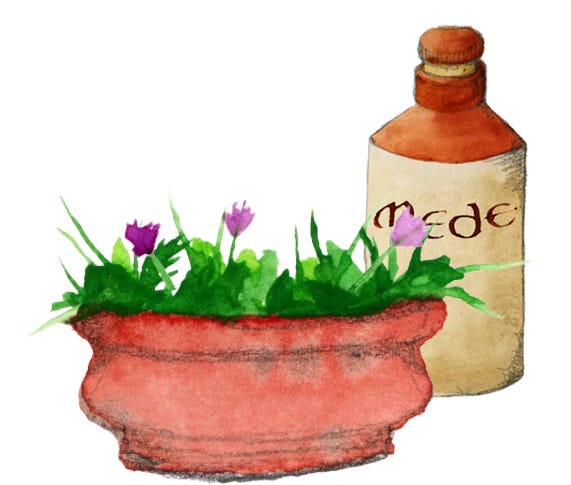
Sitting outside on a balmy summer evening, eating the fresh herb salad with a glass or two of mead, you might just find yourself gastronomically transported back to the court of King Richard II. Bon appetit!
Turning to the medicinal side of chives, the Romans saw it as a good diuretic but neither Gerard nor Culpepper thought much of Chives otherwise. Gerard wrote in 1597:
“Chives attenuate or make thinne, provoke urine, engender hot and grosse vapors, and are hurtful to the eyes and brain. They cause troublesome dreams, and work all the effects that the Leek doth.”
About fifty years later Culpepper wrote something similar:
“if they are eaten raw they send up very hurtful vapours to the brain, causing troublesome sleep, and spoiling the eye-sight; yet of them prepared by the art of the alchemist may be made an excellent remedy for stoppage of urine.”
One wonders how the alchemists persuaded scholars of the day that it required their special magical skills to bring out the diuretic properties of Chives when people had been using them raw for such purposes since Roman times. But then all ages have their equivalent of snake oil salesman and the late Middle Ages were no different with their base-metal-into-gold alchemists. The tradition carries on.
Last but not least, apparently in Devonshire, Chives were thought to be the musical instrument of the fairies. (D.C. Watts - Dictionary of Plant lore). But what type of instrument I wonder. If I were a fairy, I think I might use it - with a few puncture holes - as a flute or penny whistle perhaps?
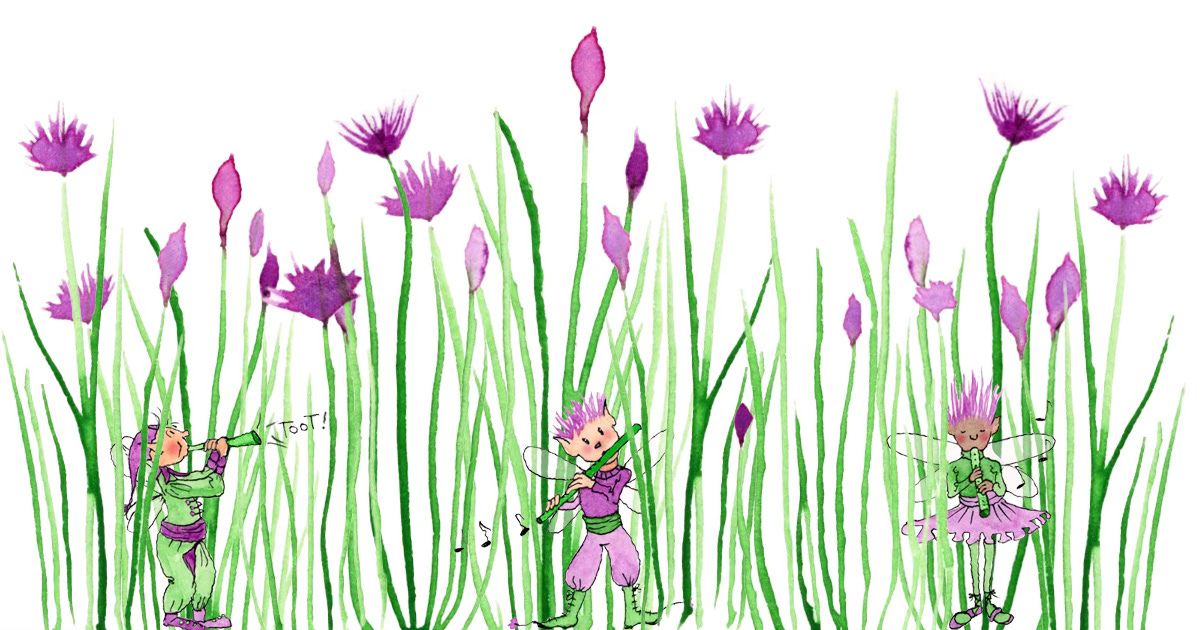
Other words for Chives are: rush-leek, sweth, and green onion.
Flowerology is a reader supported publication. To support my work you might consider to subscribe for free,
buy me a tea to help keep me awake when researching ancient herbals and plant-lore books till deep in the night (Thank you!)
or simply click the heart shaped ‘like’ button on the top or bottom of this post (it supposedly helps the algorithms). Thank you so much!
If you are looking for the etymology of a specific wildflower, you can find all flowers covered so far in Flowerology in the alphabetical archive.
A list of all the books used for researching Flowerology are in the Reading List which is frequently updated with new etymology dictionaries, herbals and plant lore books.

This newsletter is NOT a field guide for flower identification. It’s often difficult to tell the difference between harmless plants and poisonous plants and some flowers are rare and protected by law, so, NEVER pick or use any plants or flowers if you’re not sure about them.
illustrations and text ©Chantal Bourgonje
’Cury’ coms from Old French ‘queuerie’ meaning cookery
I feel compelled to add that, though plenty of charlatans did abound, alchemy wasn’t always a get rich quick scheme but in fact the origin of modern chemistry. In this case, Culpepper, a medical astrologer, seems to be saying that the raw herb is no good, but a skilled alchemist can extract and purify a pharmaceutical grade of the same herb for medical use.
Lead to gold, though considered the apex of an alchemist’s physical work, is as much a metaphor as it is an aim; many alchemists were concerned mainly with turning raw herbs (“lead”) into their most refined and potent forms (“gold”) for the purpose of helping the sick. The lore within their art insisted that the true aim of success was the betterment of mankind. Nicolas Flamel—of Harry Potter fame—was a real person who, with his wife, was reported to have achieved the philosophers stone, and history reports that they spent the rest of their days funding orphanages and hospitals.
Annnnyway if you can’t tell I’m also a history and medieval nerd, so believe me when I say I LOVE your publication.
Carry on!!!