

Chicory
Cichorium Intybus

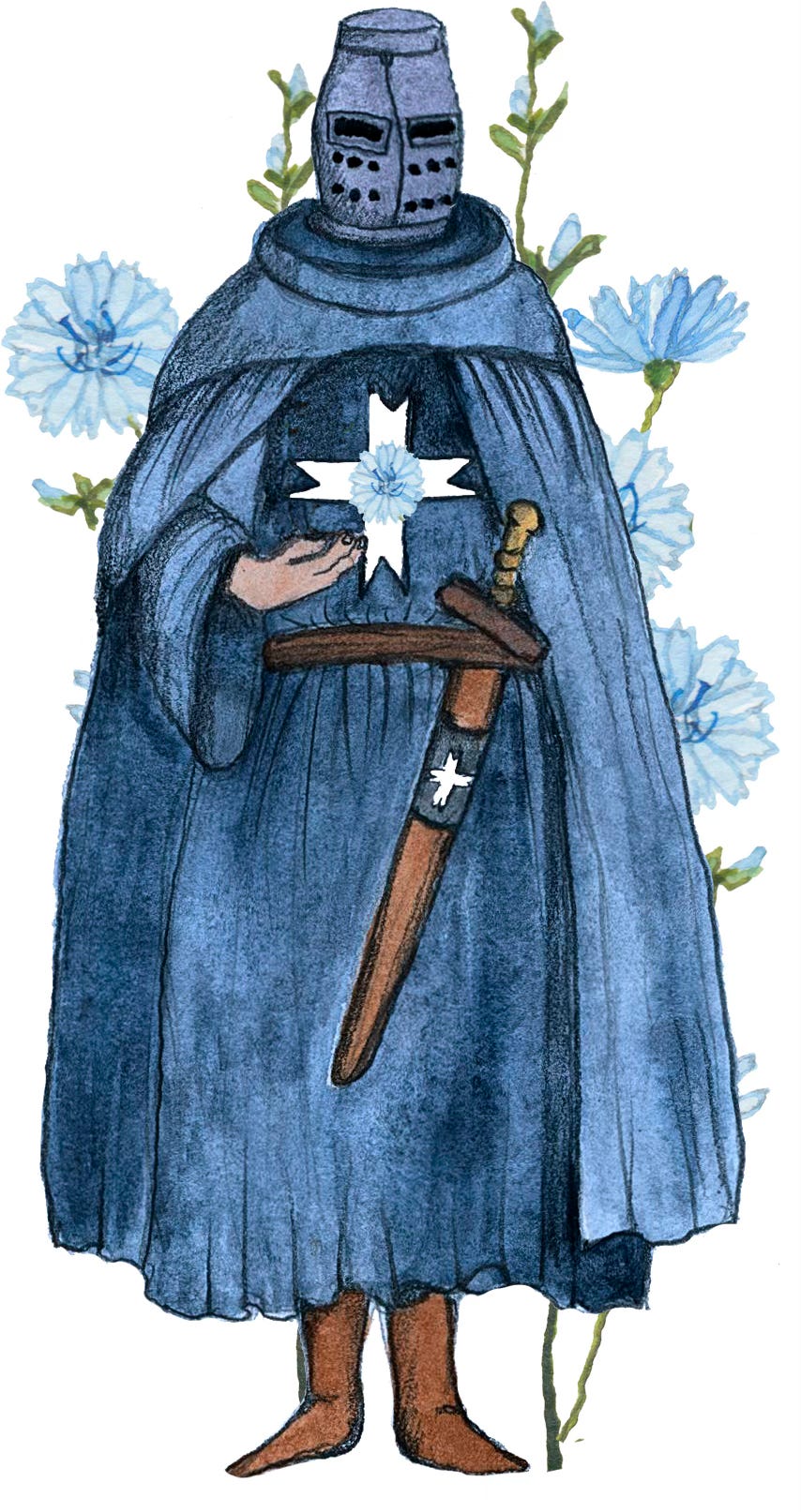
Once upon a time, a young knight fell in love with a noble lady. She had the clearest blue eyes and a smile so bright, even the sun fell in love with her.

Her name was Lady Chicory.
The young knight courted her and before long she loved him more than anything else in the world. But things were not simple. It was the year 1195, the time of the Crusades, and it was a knight's duty to fight for his king. So, when Heinrich VI, Emperor of the Holy Roman Kingdom, called on all the young men to join the Crusades and fight to restore Beirut to the Kingdom of Jerusalem, the knight had to go and leave his lady love behind.
Eight years earlier, during the previous Crusade against Sultan Saladin in 1187, fighting had been so fierce that most of the men had not returned from the war. So, quite reasonably, Lady Chicory tried everything she could think of to stop her beloved from going. She cried and she pleaded but no matter how much she wept and begged him to stay, he told her that he must go - it was his duty to save the holy land.
When it was finally time to kiss goodbye, the young knight promised he'd return but only if she promised to wait for him. And from that day on, every sunrise, Lady Chicory walked down the path where they had parted and looked into the distance, hoping to see him return. But every sunset she walked home alone.
After months and months of waiting, she became too weak to keep walking up and down the path and remained rooted to the spot. Waiting. Months and then years went by and Lady Chicory was still waiting. Rooted to the same spot. Never giving up hope. And slowly roots grew from her feet and flowers as blue as her eyes bloomed all around her.
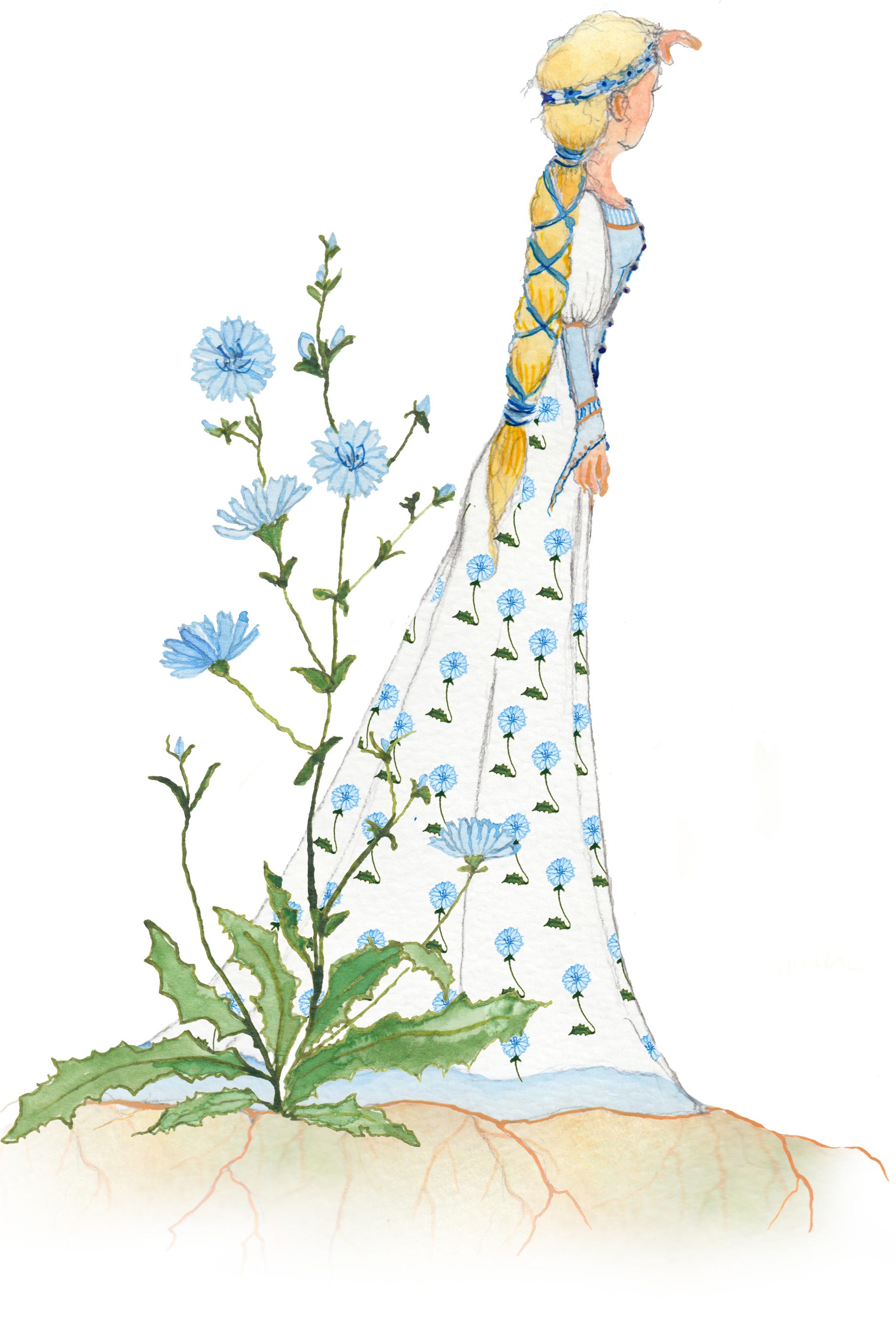
From then on, every sunrise, the bright blue flowers open up and slowly, before night falls, they close, saddened because the young knight still hasn't returned. Today you can still see Lady Chicory standing alongside fields and country lanes, her blue eyes looking out towards the sun, hoping her brave knight will one day return.
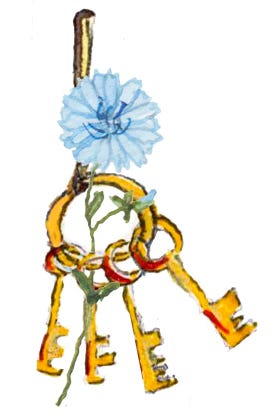
As with many of our beautiful wildflowers, Chicory has its own magic powers. You can open any lock if you cut one of the blue flowers precisely at midnight on the 25th of July, using an implement of the purest gold you can find, whilst keeping completely silent. The last bit is important, if you make any sound whilst harvesting your flower, you risk a certain death when you use it for opening a lock. So no coughing, sneezing or any other noise!
Chicory has been eaten since ancient times. The old Egyptians used to call it 'Ctchorium', and the ancient Arab word is 'Chicouryeh'. Pliny tells us that the Romans liked to eat it in salads and called it 'Succory', from Succurrere, to 'run under', as the root runs deep under the fields where it grows.
And although it tastes quite bitter Chicory root has been used as a substitute for coffee in the 1700’s and in WWII when coffee was too expensive for many, or simply not available.
Nowadays it is mainly grown as fodder for cattle. But Maude Grieve tells us it can be used in similar ways as the Dandelion, as a diuretic and a mild laxative, plus has benefits for the liver and the skin. A distillation of the flowers in water can soothe sore eyes.
Other names for Chicory are: Blue Daisy, Blue Dandelion, Blue Sailors, Blue Weed, Bunk, Coffeeweed, Cornflower, Horseweed, Ragged Sailors, Succory, Wild Bachelor's Buttons, Wild Endive and Hendibeh. There is still an Arab dish called ‘Hindbeh’ or ‘Hindba’, which is made from cooked Dandelion and Chicory leaves tossed in a lemon and olive oil dressing (some add a bit of cumin too) and topped with caramelised onions.
The scientific name ‘Intybus’ is from latin and means hollow tube, referring to the tall hollow stem of the plant.
If you enjoyed reading this, you might like to click the ‘like’ button to support my work (it helps with the algorithms apparently). And you might enjoy reading about other wildflowers too. You can easily find all posts written so far in the Flowerology alphabetical archive, which is growing every week. If you’d like to know more about the background of Flowerology and Chantal, you can read more in the about page.

This newsletter is NOT a field guide for flower identification. It’s often difficult to tell the difference between harmless plants and poisonous plants and some flowers are rare and protected by law, so, NEVER pick or use any plants or flowers if you’re not sure about them.
illustrations and text ©Chantal Bourgonje
We have chicory here, along the roadsides especially. When it blooms it feels like the end of summer is too close.
Oow, I have too many favourite flowers. The bright blue "cichorei" is one too. "Cichorei maakt me blij" is a little song I sing when I see them. Along roads (in bermen) en langs stoepranden.