
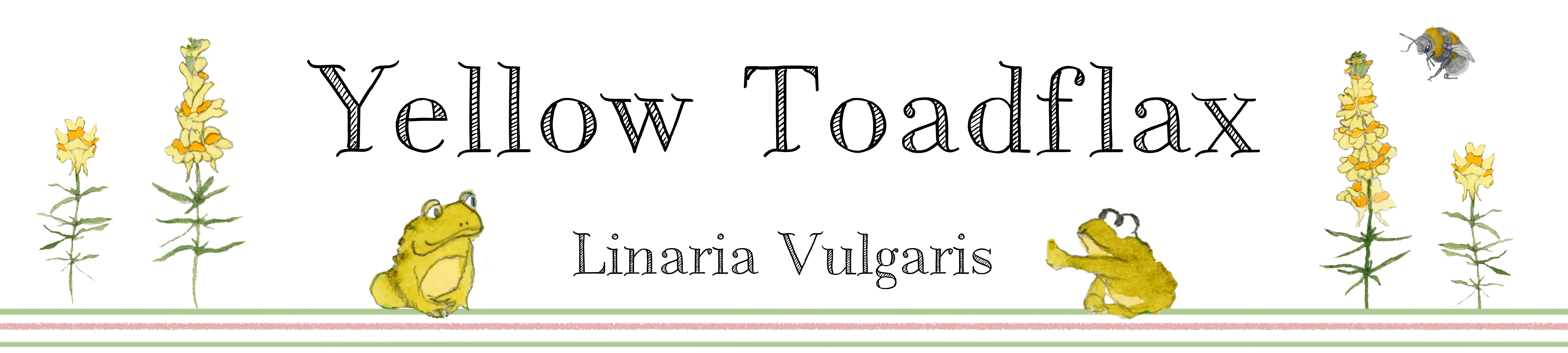
Yellow Toadflax
Linaria Vulgaris

Herbalists have been wondering how ‘Toadflax’ got its name for centuries.
The earliest attempt at an explanation can be found in the 'Ortus Sanitatus’ (1491), a German encyclopedia on the natural world and its medical applications. It describes how the plant we now know as ‘Toadflax’ could cure buboes (the painful swellings caused by the bubonic plague); the scientific name for buboes, ’bubonium’, was corrupted over time to ‘bufonium’ and then shortened to ‘bufo’ which coincidentally means toad (or a genus of toads). Rembert Dodoens, the Flemish physician and botanist, concurred about 60 years later in his ‘Herb Book’ (1554).
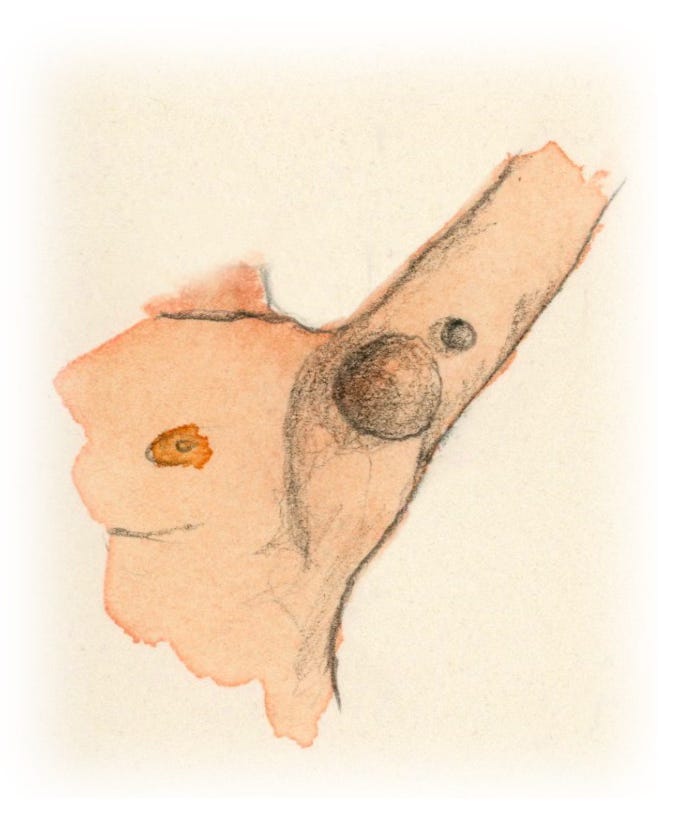
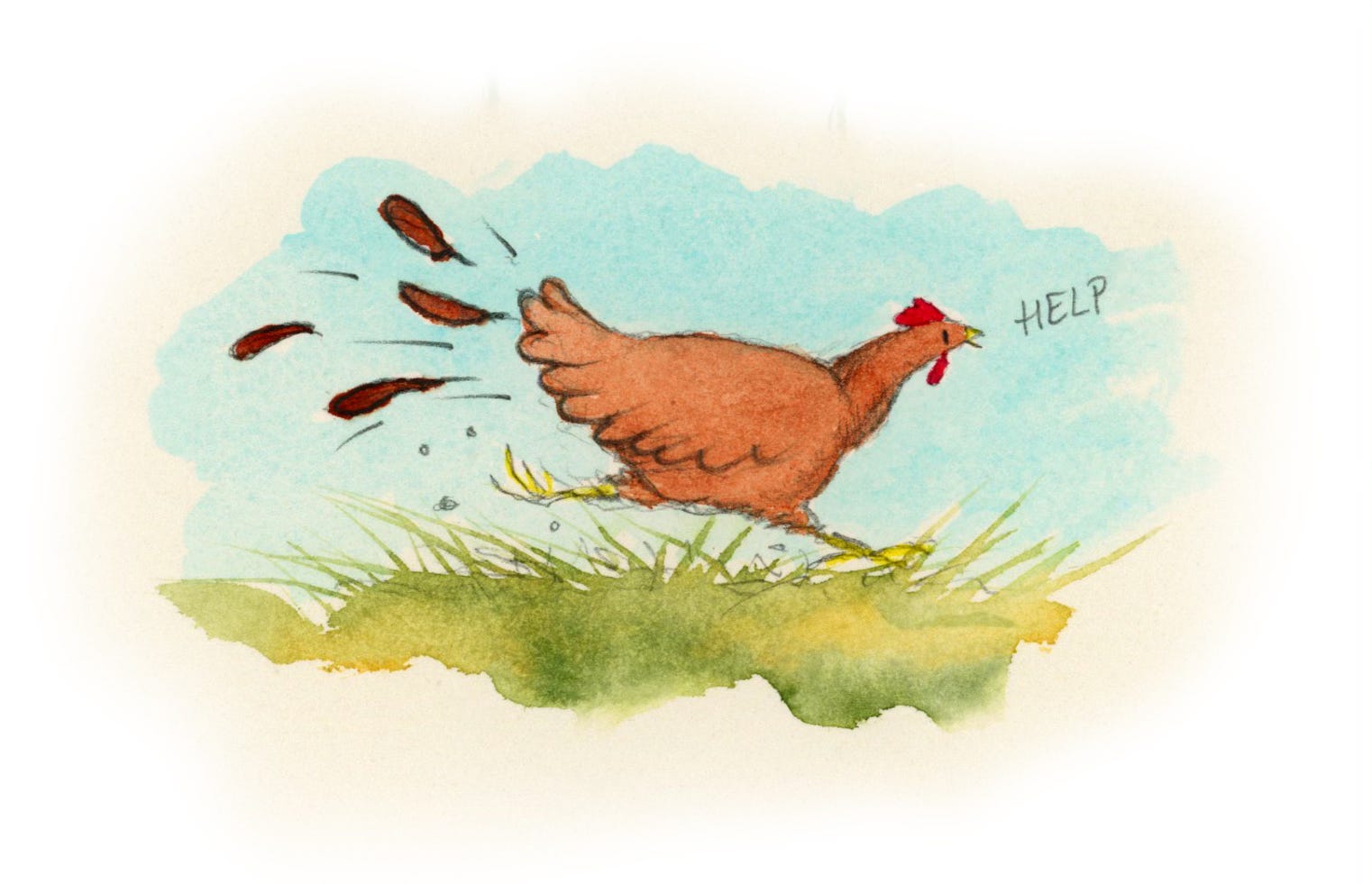
But there’s another association between toads and plague sores. In the mid thirteen hundreds when the black death was ravaging the world, a known treatment for the painful sores was the bizarre practice of tying the rear end of live, plucked chickens to the affected areas of the poor patient. Which sounds complicated, awkward and, well, just not great to inflict on a plague victim in what was likely to be his or her final hours. But then to be fair, if your chances of surviving were less than 50%, you’d probably give just about anything a try.
Then the treatment progressed from plucked chickens to toads when an anonymous and widely distributed pamphlet in Germany claimed that live toads were more efficacious than plucked chickens. This was based on Galen’s (Roman physician 129-216AD) theory of treating poison with poison. The idea was that the poisonous skin of the toads would soak up the poison in the buboes and thus heal the patient. Presumably the back end of a plucked chicken was not considered poisonous enough.
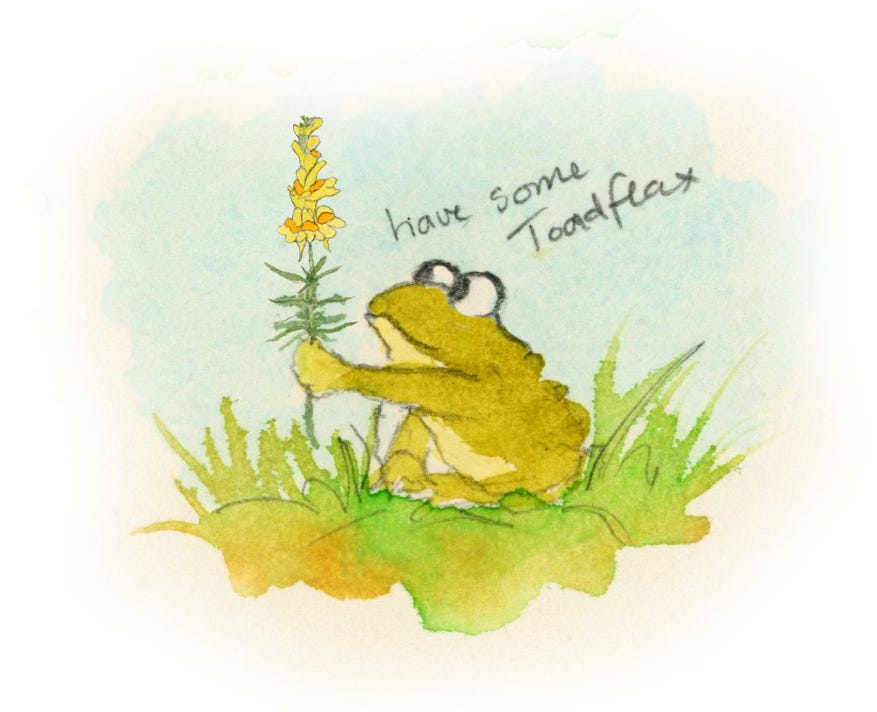
It turns out that Toadflax does have some soothing properties though. Early 20th century botanist Maude Grieve recommends Toadflax mixed with lard to sooth piles. So the link between its soothing properties and the shortened word for the sores it was supposed to ease, sounding like the word for ‘toad’, might just be the source of its name.
But there are other possibilities. John Gerard, herbalist and keen gardener, explained in the 16th century:
“It has a mouth like unto a frog’s mouth”
The flower does look a bit like like a mouth - perhaps even that of a frog or toad. In other countries there are similar references to animals’ mouths. In Holland, for instance, Toadflax is called “Leeuwenbekje” which means lion’s mouth and in Denmark and Norway people think it looks like the mouth of a cod, calling it, respectively, Torksemunn and Torskemund. In England Toadflax is sometimes called Wild Snap Dragon, the ‘snap’ presumably referring to the mouth of said dragon.
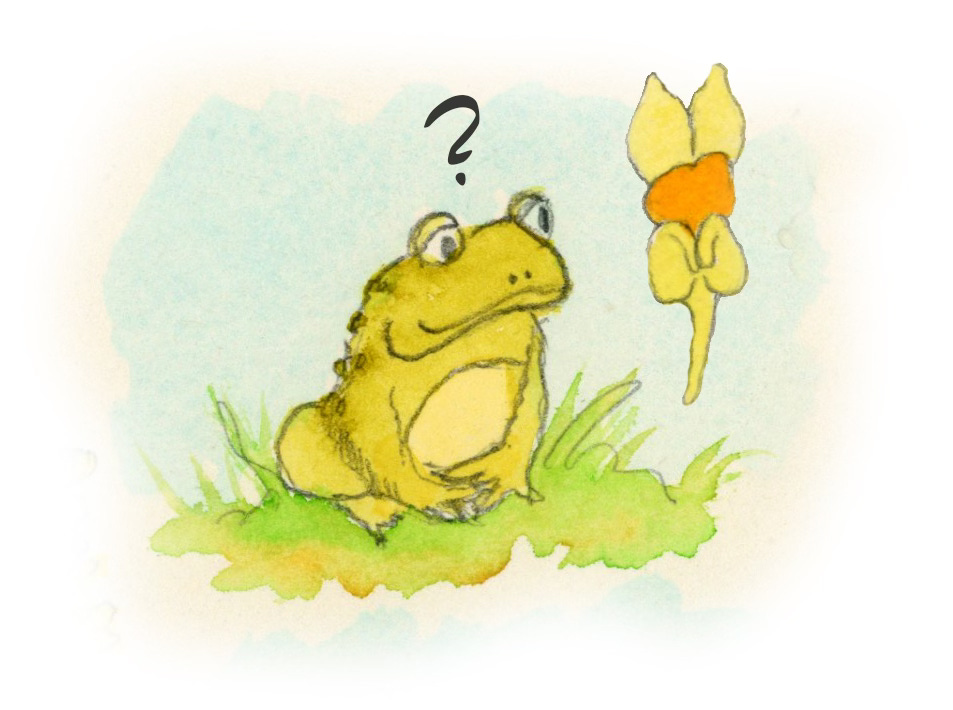
For the next explanation we need to go back again to Germany. D.C. Watts in his Dictionary of Plant Lore (2007) suggests that Toadflax came from the German words ‘Tot’ for death, and ‘Flachs’ for flax. Before it flowers, the Toadflax plant does look somewhat like common flax from which linen is made. But Toadflax would have been useless for that purpose, hence dead (or useless) flax: Tot Flachs.
Another medicinal use involves the distinctive yellow colour. In the same way that they thought the toad-like look gave the plant toad-like powers (real or imagined) the yellow colour of the flowers made people believe that Toadflax could cure conditions that had a relationship with the colour yellow. For example urinary trouble, liver conditions and jaundice. John Gerard for example wrote that Toadflax would:
“provoke urine, in those that pisse drop by drop”
And if that wasn’t enough, in ‘Somerset Folklore’ by R. L. Tongue (1965) we read that you can use Toadflax to get rid of warts. Just rub it on. The same way that we, as children in 1970’s Holland, used to say that rubbing toads on your verrucas would cure them.

Perhaps the most endearing explanation was given by botanist William Coles (1626–1662), who thought that toads liked to shelter under Toadflax. One wonders where he got the idea. Maybe he stumbled across a group of toads one day, using the flowering plants like an umbrellas. With all the other stories attributed to Toadflax, who knows.
There are many different names for Toadflax. Most of them either referring to the look of the flowers or being false flax. Butter and eggs, Butter haycocks, Bread and butter, Bunny haycocks, Bunny mouths, Calf's snout, Dead men's bones (after the skeletal look of the plant when it has finished flowering), Devil's flax, Devil's flower, Doggies, Dragon bushes, Eggs and bacon, Eggs and butter, False flax, Flaxweed, Fluellen, Jacob’s ladder, Lion's mouth, Monkey flower, Rabbit flower, Ranstead, Wild flax, Wild tobacco, Yellow rod and Gallwort (as it tastes very bitter).

Flowerology is a reader supported publication. To support my work you might consider to subscribe for free, buy me a tea or simply click the heart shaped ‘like’ button on the top and bottom of this post (it helps the algorithms apparently). Thank you!
You might also enjoy reading about other wildflowers. You can find all flowers covered in Flowerology so far, in the alphabetical archive. And you can find a list of all the books used for researching Flowerology in the Reading List.

This newsletter is NOT a field guide for flower identification. It’s often difficult to tell the difference between harmless plants and poisonous plants and some flowers are rare and protected by law, so, NEVER pick or use any plants or flowers if you’re not sure about them.
illustrations and text ©Chantal Bourgonje
Fascinating if a little disturbing 🤣
Voorheen werd de plant vlasleeuwenbekje genoemd, tegenwoordig ingekort tot vlasbekje 💛