

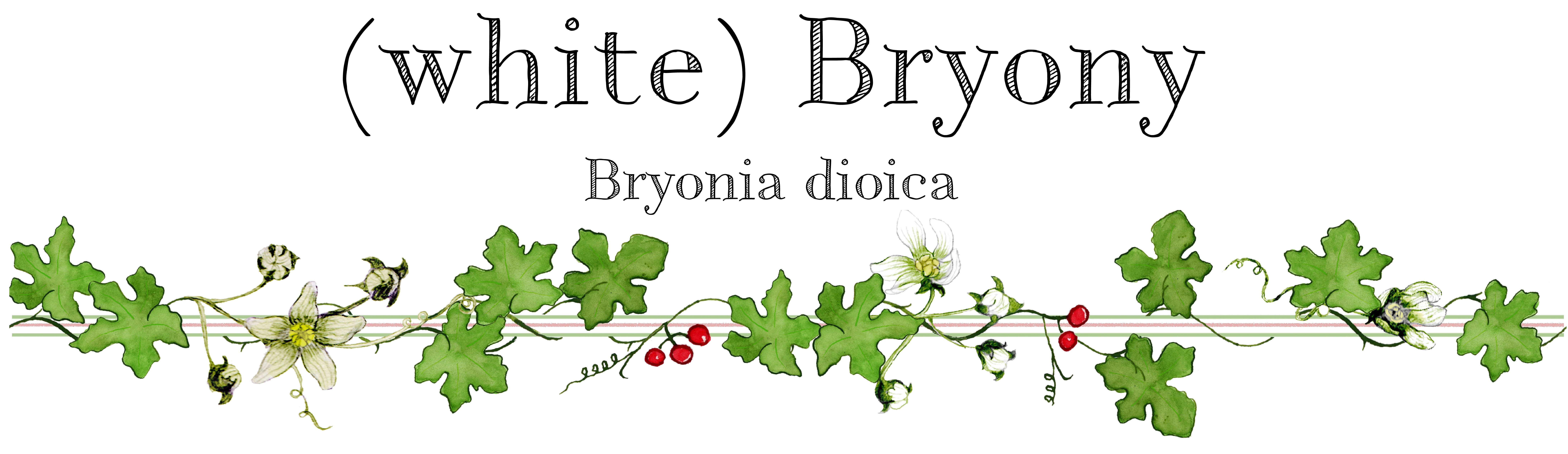
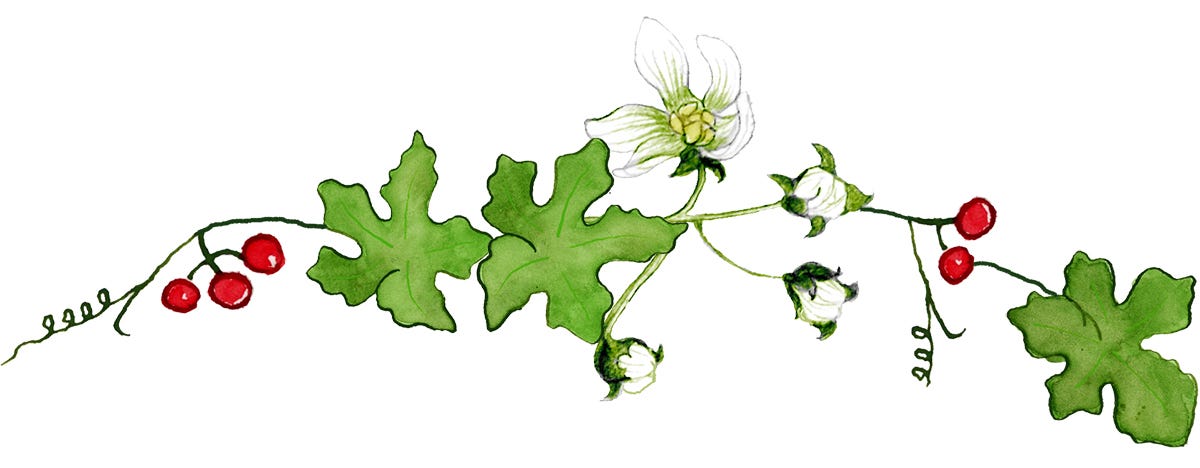
(white) Bryony
Bryonia dioica

For centuries in England, Bryony root was sold by unscrupulous dealers as Mandrake root, which it resembles. Just about. Mandrake root was renowned for its magical powers but it was scarce, being mostly imported from the Mediterranean, and so commanded a high price. Which would have attracted the attention of the conmen. To push the price up higher, and making the roots even scarcer, the process of harvesting the plant was thought to be highly dangerous: it was said that if you pulled Mandrake out of the ground, the plant’s screams would be so terrifying that hearing them would kill you. Which one can imagine might put off more than a few potential harvesters.
Bryony root doesn’t have a reputation for powerful magic, but then it doesn’t have a reputation for screaming you to death when you pull it out of the ground either, and it also grows abundantly. So one can see the attraction of passing the roots off as Mandrake. If you were that way inclined.
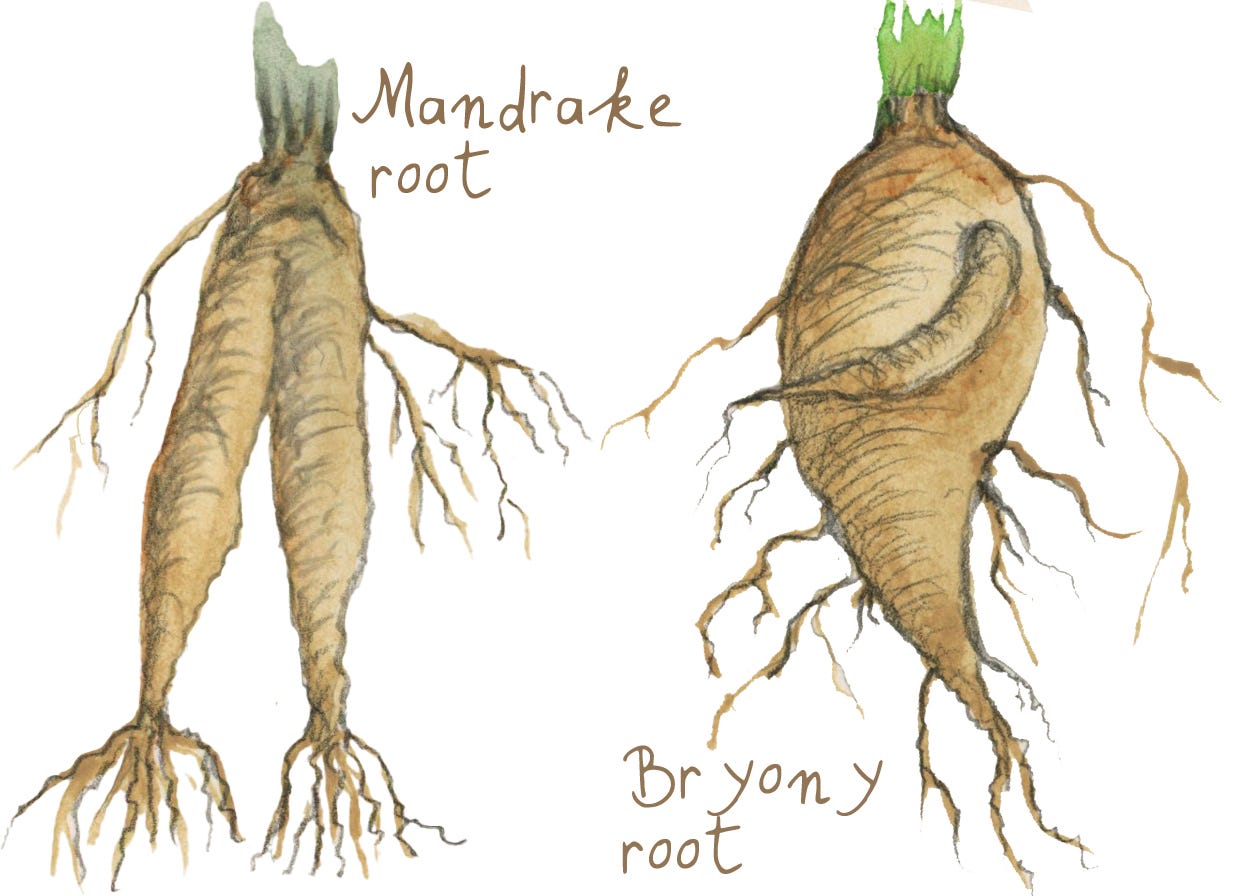
The roots, however, don’t look identical. And swindling folk out of their hard-earned could be a dangerous game. To make the deception more convincing the con-artists would often carve the Bryony roots to make them look more like the human shape of Mandrake root. And sometimes they got away with it. Not everyone was taken in though. Famous herbalist John Gerard (1545-1612) was unimpressed:
“But the idle drones that have little or nothing to do but eat and drink, have bestowed some of their time in carving the roots of Bryony, forming them to the shape of men and women: which falsifying practice hath confirmed the error amongst the simple and unlearned people, who have taken them upon their report to be the true Mandrakes.”
1,500 years earlier, Pliny the Elder (23-79AD), had a different use for the root. He claimed that the root pounded together with figs and rubbed into your face, followed by a brisk walk of a quarter of mile, would reduce wrinkles. Not sure how the walking helps with wrinkles, but more worryingly just touching the root can cause rashes and blisters. Not ideal for a daily beauty routine.
The earliest mention of Bryony I’ve found is in Pliny’s encyclopaedia the “Naturalis Historia” (AD 77) where the word ‘Bryonia’ or ‘Brionia’ was the name given to the plant. Then in the 4th century Pseudo Apuleius in his illustrated “Herbarium1”, which was based on earlier Latin texts, continued using ‘Brionia’. When this popular book was translated into Old English in the 10th century, Brionia replaced the existing old English word ‘hymele’ which was then the word for Bryony (and for other climbing and binding plants generally). By the 14th century it was called ‘Brione’.
In chapter 67 of the Herbarium, Pseudo Apuleius referred to the Bryony’s toxic berries, which were used to cure leather. Apuleius also mentions that the dried root was a remedy for troubles with the spleen. But as it’s highly poisonous it was probably best only used in tiny quantities - if reasonable survival rates were hoped for. He was obviously aware of Bryony’s strength, as he writes it was such a powerful herb it was one of the 67 ingredients of ‘Theriac’ (also known as ‘Mithridatium’) a super miracle cure for just about anything, including Oliver Cromwell’s acne. For more about Mithridatium (and ancient serial killer King Mithridatus Eupator VI), see our post on Agrimony.

Nicholas Culpeper (1616-1654), and 1,200 years after Pseudo Apuleius, still suggests Bryony root as a remedy for spleen troubles, as well as a treatment for a wide range of other ailments. But at least he warns us:
“the roots of Briony purge the belly with great violence, troubling the stomach, and burning the liver, and are therefore not rashly to be taken”
But then he just as easily writes:
“an electuary, made of the roots and honey, mightily cleanses the chest of rotten phlegm”
Well you might have got rid of your rotten phlegm, but then again you might not have been around afterwards to enjoy the clear chest.
Regarding the Scientific name, Bryonia originates from the Greek word ‘bryo/bruo/brúon’ which means fast growing. And it certainly is. Dioica means ‘from two houses’, which is used for plants that have male and female flowers growing on separate plants.
Other names for Bryony are mostly referring to the highly poisonous nature of the plant: Dead Creepers, Death Warrant, Snake Berry, Poisoning Berries, Woman Drake (instead of Mandrake), and Wild Cucumber (it is a plant in the cucumber family).
Flowerology is a reader supported publication. To support my work you might consider to subscribe for free,
buy me a tea to help keep me going when researching ancient herbals and plant-lore books. (Thank you!)
or simply click the heart shaped ‘like’ button at the very top or bottom of this post. Thank you so much!
If you are looking for the etymology of a specific wildflower, you can find all flowers we covered so far in the alphabetical archive. And a list of all the books used for researching Flowerology are in the Reading List .

This newsletter is NOT a field guide for flower identification. It’s often difficult to tell the difference between harmless plants and poisonous plants and some flowers are rare and protected by law, so, NEVER pick or use any plants or flowers if you’re not sure about them.
illustrations and text ©Chantal Bourgonje
The “Herbarium” by Pseudo Apuleius is an early medieval manuscript based on Latin texts including Pliny’s “Naturalis Historia” and Dioscorides’ book “De Materia Medica” and others.
Ah, ik moest even zoeken naar de Nederlandse naam: heggerank.
It’s a popular name for a girl, which is odd given its toxicity. 😳