

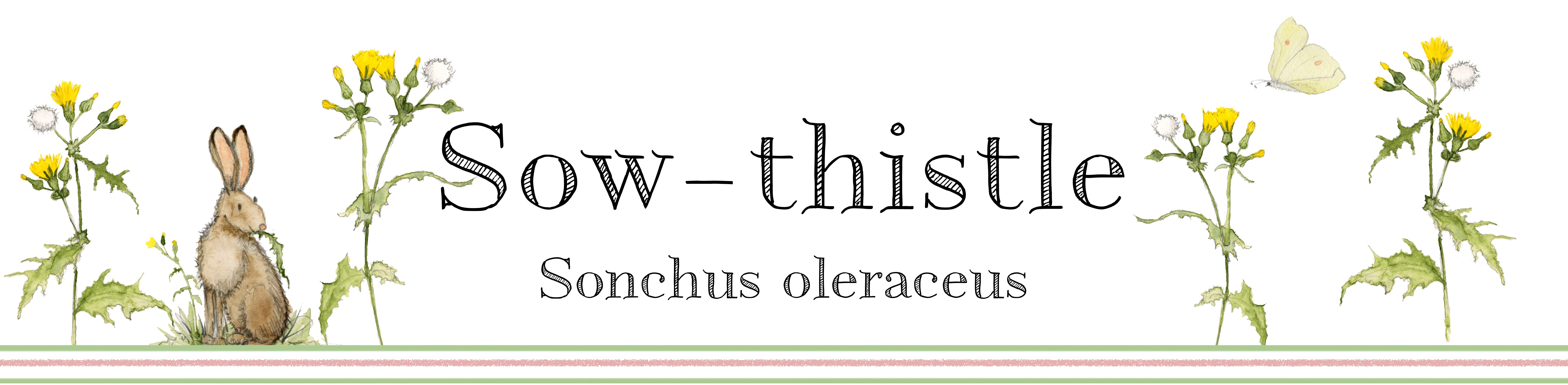
Sow-thistle
Sonchus oleraceus

If you’re looking for a healthy culinary ingredient, suffer from warts or need to ward off the devil, Sow-thistle could be the herb for you. And luckily it likes to grow just about anywhere, so you won’t have to travel far to get a bunch.
Eating a thistle might not immediately appeal, but apparently the young leaves, cooked as you would spinach, or with the spikes cut off as a salad, make a healthy snack. The plant is full of vitamins and antioxidants. You normally don’t eat the stem as its milky sap makes it taste bitter, but you can save the stalks and use the sap to treat warts, if you or your friends are unfortunate enough to have any. In addition, if you’re worried about being pursued by the devil, it was said in most European countries, that carrying a Sow-thistle leaf with you would repel him. But, not in Russia, where the devil apparently likes a bit of Sow-thistle. Which could have made life a little hazardous on the boarders.
In Old English (450AD -1100AD) the plant was called ‘þufeþistel’ or ‘þuþistel’, (the letter ‘þ’ is pronounced as our modern ‘th’). Þufeþistel means ‘sprout thistle’ which, according to Richard Prior (1863) indicated in those days that its young shoots and leaves were valued as food. ‘Þufeþistel’, not being an easy word to pronounce, with all those lisping and spitting ‘th’, ‘f’ and ’s’ sounds, it’s easy to understand how the word evolved into ‘Sow-thistle’ over time. By 1491, and en route to becoming ‘Sow-thistle’ it was called ‘Suwe-distel’ and ‘Saw-distel’ in the ‘Ortus Sanitatis’ (printed in Germany).
The scientific name Oleraceus also refers to its edibility. The Latin word ‘olus’ or ‘holus’ means vegetable or potherb. Keen gardener and herbalist John Gerard (1545-1612) wrote in his almost 1,500 pages long ‘Herball’ (published in 1597) that young Sow-thistle leaves are much appreciated as a salad with oil and vinegar in Tuscany, where he claimed it grew in abundance. Although about 100 years later, John Ray, writer of the ‘History General’s Planetarium’ (1690), was less impressed with its use as a vegetable. He wrote:
“We leave it to be masticated by hares and rabbits.”
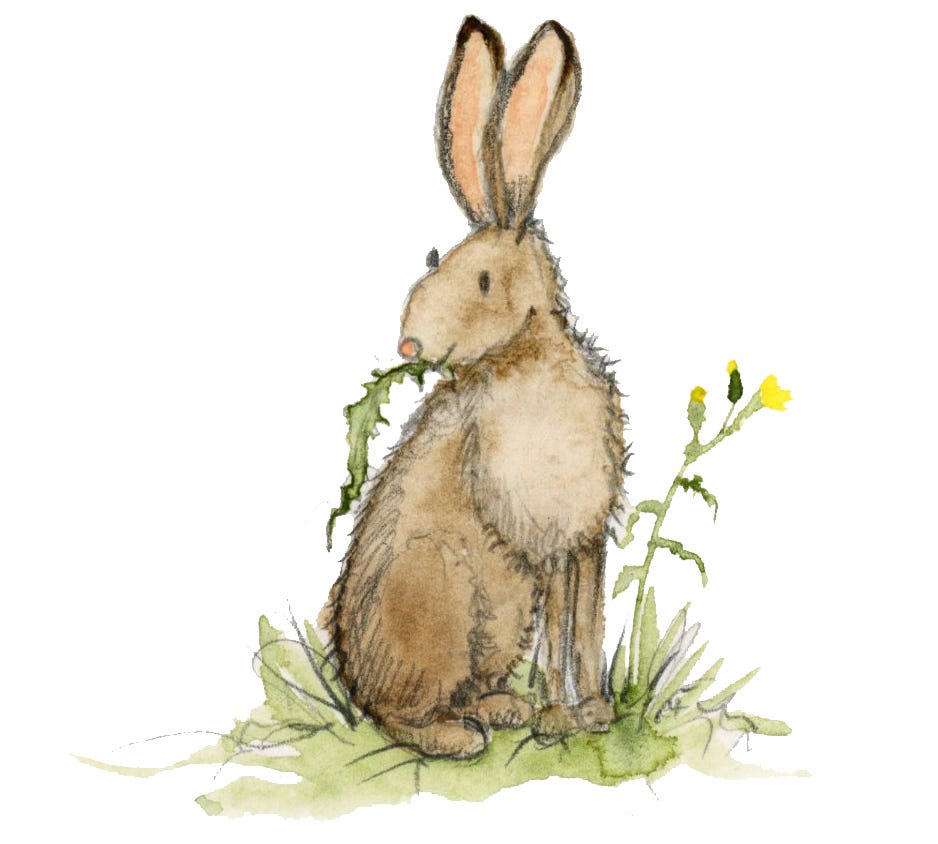
Sow Thistle is indeed also known as Hare’s Lettuce, Hare’s Colewort, Hare’s Thistle, Rabbit’s meat and Rabbit’s Victuals. There’s also the name ‘Hare’s Palace’ or ‘Hare’s House’, which is the name Peter Treveris (a book printer working in Southwark, London between 1522 - 1532) used for the plant in his “Grete Herball” (1526):
“If the hare come under it, he is sure that no beast can touch him.”
Botanist William Cole (1626-1662), was an authority of the time on medicinal plants and their uses. He was very keen on what he called the ‘Art of Simpling’ or ‘Herbal Simples’, which was similar to sympathetic magic (linking and attributing a plant’s medicinal properties to the way it looked). He claimed that the plant was called ‘Sow-Thistle’ because sows have a natural instinct for knowing they should eat it after giving birth. Supposedly to helping the milk flow to their little piglets. Similar to its relative the Dandelion, the stem of the Sow-Thistle contains - as previously mentioned - a white, milky sap. For this reason it was thought that if the sap of the plant looked like milk, it would help a sow’s milk flow. And pigs do like it. Whether it helps their milk-flow remains uncertain, though it will give the munching sows a healthy dose of vitamins A, B, C and K, plus zinc, iron, calcium and potassium. What more could a pig - or a little piglet - ask for?
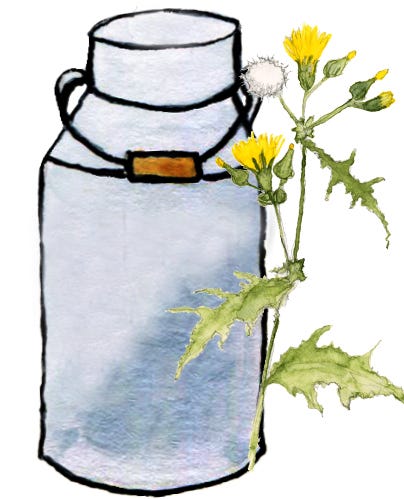
There are many other milk related names for ‘Sow-thisle’: Milkweed, Milkwort, Milky Dassel (or Dashel), Milky Dickle, Milky Dissel and Milk Thistle. The latter being similar to the Dutch word for Sow-thistle- ’Melk Distel’. In Sweden it is called ‘Kålmolke’ - ‘Cabbage Milk’ and the Danes call it ‘Svinemælk’ - ‘Pig’s milk’.
Worryingly, and inducing the odd wince or two on first reading, Nicholas Culpeper (1616-1654) suggested to use bruised Sow-thistle leaves to sooth piles. Luckily, for pile-sufferers, Culpeper also mentioned that a strong infusion of Sow-thistle, either taken inwardly or applied with a sponge, works just as well. Absolutely no contest, I would have thought.
The scientific name ‘Sonchus’ comes from the Greek word ‘Somphos’, which means weak or hollow and refers to the hollow stem, which easily breaks.
Other names for Sow-thistle are ‘Sow flower’, ‘Swinies’, ‘Sow bread’ and ‘Sow dingle’.

Flowerology is a reader supported publication. To support my work you might consider to subscribe for free,
buy me a tea to help keep me awake when researching ancient herbals and plant-lore books till deep in the night (Thank you!)
or simply click the heart shaped ‘like’ button at the very top or bottom of this post. Thank you so much!
If you are looking for the etymology of a specific wildflower, you can find all flowers covered so far in Flowerology in the alphabetical archive.
A list of all the books used for researching Flowerology are in the Reading List which is frequently updated with new etymology dictionaries, herbals and plant lore books.

This newsletter is NOT a field guide for flower identification. It’s often difficult to tell the difference between harmless plants and poisonous plants and some flowers are rare and protected by law, so, NEVER pick or use any plants or flowers if you’re not sure about them.
illustrations and text ©Chantal Bourgonje
Fascinating post as always ... I think this is your first Flowerology post for a month or two and I was missing them! Hope everything's OK.
Ha ha! Those masticating hares. Gotta watch out for them!