
Lesser Knapweed
Centaurea Nigra

‘Centaurea’, is one of two main plant families named after the Centaurs. The Ancient Greeks called Knapweed ‘Kentaureion’ and the Romans called it ‘Centaurea’, both meaning plant of the Centaurs.
Like Common Centaury (Centaurum Erythraea), Lesser Knapweed (Centaurea Nigra) was claimed by different herbalists to be the plant that Chiron, the Centaur of mythology, used to treat the poisoned arrow wound that was accidentally inflicted on him by Heracles. (You can read Chiron’s tragic story in the post on Centaury.)
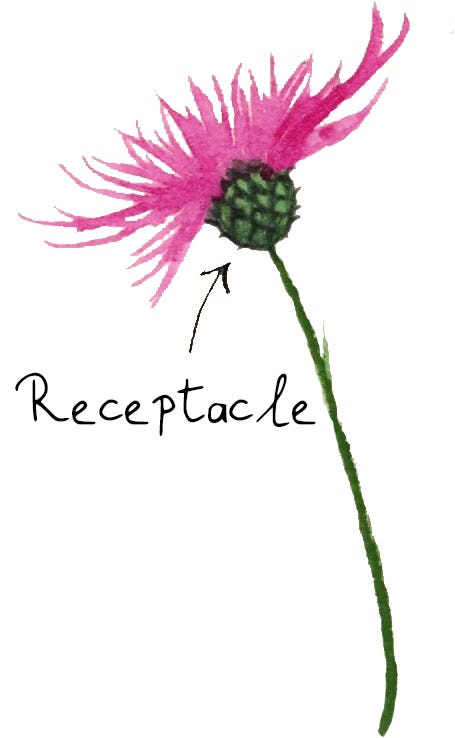
Well into the 16th century ‘Knapweed’ was called ‘Knop-weed’. The word ‘Knop’ is related to the Dutch word ‘Knoop’ and the German word ‘Knopf’, both meaning button. In Old and Middle English you would still pronounce the letter “k”, as you do today in both Dutch and German. ‘Knop’ (also the origin of the word ‘knob’) meant a growth or nodule, something bulbous that protrudes. In the case of Knapweed it refers to the button-like receptacle (the flower’s attachment to the stalk).
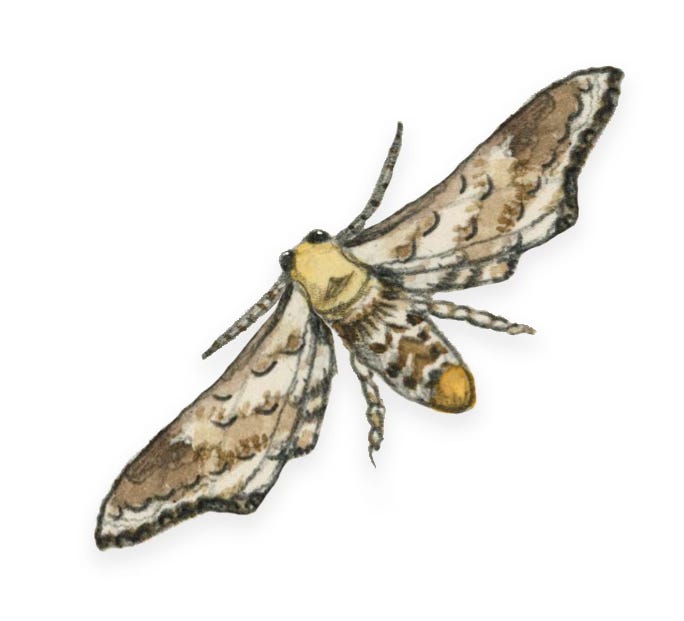
As we learned with Chickweed, the word ‘weed’ comes from Old English ‘weod’ meaning undesired or troublesome plant. But as weeds go it’s really not all bad. Next to its flowers being beautiful, Knapweed is a great source of food for all types of pollinators: butterflies, bees, hoverflies beetles and night-flying moths. They all love its nectar, which is important these days with insect population levels having fallen as much as they have.
In addition, the 9th century Old English book ‘Lacnunga’ (Remedies) claims Knapweed was also a great cure for ‘wyrms’ that were burrowing under your skin.(The Anglo-Saxons deemed that ‘wyrms’ together with flying venom, elf-shot and dwarfs were the main causes of illness and disease.)
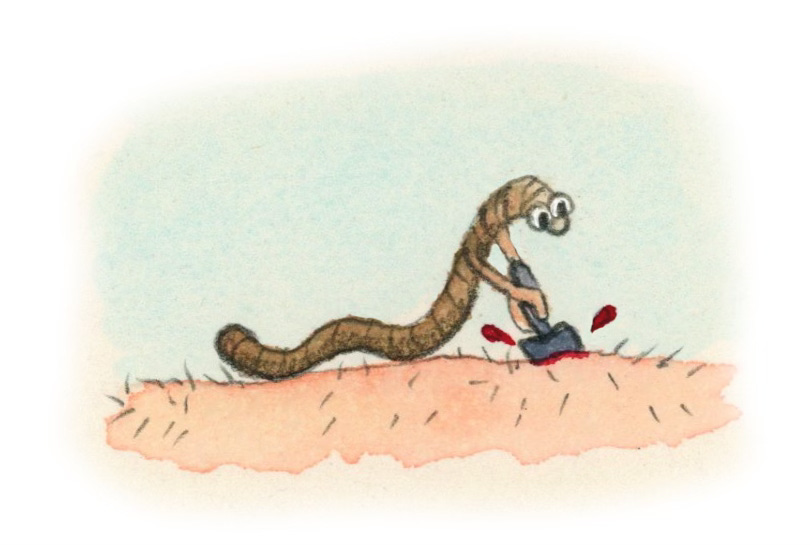
When you suspected you had one or more ‘wyrms’ boring under your skin, the suggested remedy involved spitting on the affected area and rubbing in lots of Knapweed whilst someone chanted the following words that, to this day, have not been translated.
“Gono mil orgo mil marbu mil marb sair amum tofeð1 tengo do cuido biran cuiðær cæfmiil scuiht cuillo scuiht cuib duill marb sir amum.”
The incantation was to be delivered nine times, into the left ear if you were a woman and in the right ear if you were a man. Followed in each case by one ‘Our Father’.
Later, herbalists wrote that Greater Knapweed (Centaurea Scabiosa) could be used to cure ‘felons’ or ‘whitlows’ which are abscesses or infections near your finger or toe nails. I wonder if perhaps when the Anglo Saxons wrote about ‘wyrms’, they might have been describing painful swellings caused by infections and abscesses.
And there’s more! Folklore tells us that in order to check whether a couple were a suitable pairing for marriage, both parties should each pull off all the petals of a Knapweed flower and at bedtime place the bare bud next to their hearts. If one or more new petals had grown in the morning - for both parties - book the church. If only one of the lovers had a new petal, perhaps better not risk it - particularly if you were the one with the new petal. If neither party had a fresh petal run for the hills - both of you - the marriage was doomed. A similar divination practice, but one for making wishes come true, was introduced by the Vikings, using Ribwort Plantain.
To sum it up, Knapweed is great for pollinators, can get rid of your burrowing ‘wyrms’, predict whether the object of your desire will stay true, and has beautiful blooms. What’s not to like? The ‘weed’ part of the name feels rather undeserved.
The 2nd part of the scientific name, ‘Nigra’ means black and is in reference to the dark lines on the receptacle.
Other names for Knapweed are: Hardhead, Hardirons, Round Heads, Iron Heads, Loggerheads, Sweeps, Black Centaury, Spanish Buttons and Knobweed. All describe the hard round receptacles, apart from ‘Sweeps’, which refers to the shape of a chimneysweep’s brushes.
Flowerology is a reader supported publication. To support my work you might consider to subscribe for free, buy me a tea or simply click the heart shaped ‘like’ button. Thank you!
You might also enjoy reading about other wildflowers. You can find all flowers covered in Flowerology so far, in the alphabetical archive. And you can find a list of all the books used for researching Flowerology in the Reading List.
This newsletter is NOT a field guide for flower identification. It’s often difficult to tell the difference between harmless plants and poisonous plants and some flowers are rare and protected by law, so, NEVER pick or use any plants or flowers if you’re not sure about them.
illustrations and text ©Chantal Bourgonje
ð was pronounced as ‘th’ in modern English
Thank goodness we’ve eradicated that elf-shot!
My go-to-flower for attracting pollinators - knapweed in my meadows is covered with butterflies